
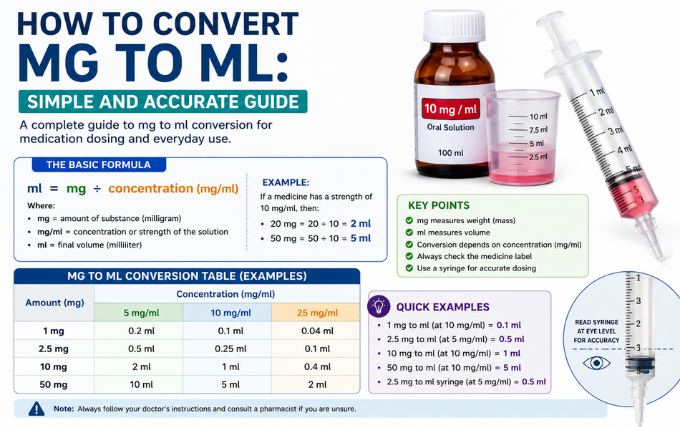
Understanding mg to ml conversion is essential in medicine, pharmacy, cooking, chemistry, and many scientific fields. However, many people get confused because milligrams (mg) measure mass, while milliliters (ml) measure volume. This means you cannot directly convert mg to ml without knowing an important factor: the concentration or density of the substance.
What is mg to ml?
Before learning mg to ml conversion, it’s important to understand the difference between these two units:
- mg (milligram): Measures weight or mass
- ml (milliliter): Measures volume (liquid space)
Because they measure different things, converting mg to ml is not fixed like converting centimeters to meters. Instead, it depends on how much substance is dissolved in a liquid.
For example:
- 1 mg of water is not the same volume as 1 mg of honey or medicine syrup.
- Medicines often have a defined strength like mg per ml (mg/ml).
The Basic Formula for mg to ml Conversion
The most important formula used in mg to ml conversion is:
ml = mg ÷ concentration (mg/ml)
Where:
- mg = amount of substance
- mg/ml = concentration of the solution
- ml = final volume
Example:
If a medicine has a strength of 10 mg/ml, then:
- 20 mg = 20 ÷ 10 = 2 ml
- 50 mg = 50 ÷ 10 = 5 ml
This is the foundation of all mg to ml drug conversion calculations.
Why mg to ml Conversion is Important
The mg to ml conversion is widely used in:
- Hospitals and pharmacies
- Syringe dosing
- Pediatric medicine
- Liquid medications
- Laboratory solutions
A small mistake in conversion can lead to incorrect dosing, especially in medicine. That’s why healthcare professionals rely on accurate formulas or an mg to ml calculator for precision.
Understanding mg to ml Drug Conversion
The most common real-life use of mg to ml conversion is in medications.
Most liquid medicines are labeled like this:
- 5 mg/ml
- 10 mg/ml
- 25 mg/ml
This tells you how many milligrams of medicine are present in each milliliter of liquid.
Example in Drug Conversion:
If a doctor prescribes 25 mg, and the syrup strength is 5 mg/ml:
- 25 ÷ 5 = 5 ml of syrup
This is called mg to ml drug conversion, and it ensures safe and accurate dosing.
Using an mg to ml Calculator or Converter
Many people prefer using an mg to ml calculator or mg to ml converter because manual calculation can be confusing.
These tools:
- Automatically convert mg to ml
- Reduce human error
- Save time
- Are especially helpful for medical dosing
You simply enter:
- mg value
- concentration (mg/ml)
And the tool gives you the correct ml value instantly.
Common mg to ml Conversions (With Examples)
Let’s look at some simple mg to ml conversion examples. Remember, these are based on a common assumption where concentration is clearly defined.
1 mg to ml
If concentration = 1 mg/ml:
- 1 mg = 1 ml
If concentration = 10 mg/ml:
- 1 mg = 0.1 ml
2.5 mg to ml
This is a commonly asked conversion, especially in medicine.
If concentration = 5 mg/ml:
- 2.5 mg = 0.5 ml
If concentration = 10 mg/ml:
- 2.5 mg = 0.25 ml
👉 This is often used in 2.5 mg to ml syringe measurements.
10 mg to ml
If concentration = 5 mg/ml:
- 10 mg = 2 ml
If concentration = 10 mg/ml:
- 10 mg = 1 ml
50 mg to ml
If concentration = 10 mg/ml:
- 50 mg = 5 ml
If concentration = 25 mg/ml:
- 50 mg = 2 ml
2.5 mg to ml Syringe Measurement
A 2.5 mg to ml syringe measurement is commonly used for children’s medication or precise dosing.
For example:
- If medicine strength is 5 mg/ml
- 2.5 mg = 0.5 ml
Doctors often prescribe such small doses to ensure safety and avoid overdosing. Syringes marked in ml help measure liquid medicine accurately.
Why mg to ml Conversion is Not Always Fixed
One of the biggest mistakes people make is assuming there is a universal mg to ml conversion. In reality, it depends on:
1. Concentration of the solution
Different medicines have different strengths (mg/ml).
2. Substance density
Solid vs liquid vs dissolved substances behave differently.
3. Medical formulation
Different brands may have different concentrations for the same drug.
That’s why mg to ml conversion must always be checked carefully.
mg to ml Conversion Table (Simple Guide)
| mg Value | 5 mg/ml | 10 mg/ml | 25 mg/ml |
| 1 mg | 0.2 ml | 0.1 ml | 0.04 ml |
| 2.5 mg | 0.5 ml | 0.25 ml | 0.1 ml |
| 10 mg | 2 ml | 1 ml | 0.4 ml |
| 50 mg | 10 ml | 5 ml | 2 ml |
This table shows how mg to ml conversion changes depending on concentration.
mg to ml Conversion in Everyday Life
While mostly used in healthcare, mg to ml conversion is also useful in:
- Liquid supplements (vitamins, syrups)
- Laboratory experiments
- Chemistry solutions
- DIY formulations (like essential oils mixtures)
In all cases, the same rule applies: you must know the concentration first.
Common Mistakes in mg to ml Conversion
Here are some common errors people make:
1. Assuming mg always equals ml
This is incorrect because they measure different things.
2. Ignoring concentration
Without mg/ml strength, conversion is meaningless.
3. Incorrect syringe measurement
Especially in 2.5 mg to ml syringe use, small errors can cause overdose or underdose.
4. Using wrong calculator inputs
Even an mg to ml calculator gives wrong results if concentration is entered incorrectly.
Tips for Accurate mg to ml Conversion
To ensure correct mg to ml conversion, follow these tips:
- Always check medicine label for mg/ml strength
- Use a reliable mg to ml converter
- Double-check calculations for medicine doses
- Use syringes marked in ml for accuracy
- Consult a pharmacist or doctor if unsure
Conclusion
The concept of mg to ml conversion is simple once you understand the key principle: it depends on concentration. There is no universal formula without knowing mg/ml strength.
Whether you are dealing with mg to ml drug conversion, using an mg to ml calculator, or measuring a 2.5 mg to ml syringe, accuracy is extremely important—especially in medical situations.
To summarize:
- mg = weight
- ml = volume
- conversion depends on mg/ml concentration
Once you master this simple rule, all conversions like 1 mg to ml, 2.5 mg to ml, 10 mg to ml, and 50 mg to ml become easy and accurate.
